
.svg)
Workplace Acoustic Solutions for Office Performance in Davos
Discover how workplace acoustic solutions enhance office performance in Davos, boosting focus and productivity with proven design strategies.

Workplace acoustic solutions are architectural and technological interventions that control sound levels, reduce noise distractions, and protect speech privacy in corporate environments. For office managers and design professionals working in Davos, where high-altitude corporate retreats and year-round business operations demand focused, professional environments, getting acoustics right is not optional. The industry standard framework is the ABC methodology: absorb, block, and cover. When applied correctly in a Davos office environment, this approach directly improves focus, reduces cognitive fatigue, and supports compliance with WELL v2 Feature 74, the leading international wellness certification standard for workplace sound.
How workplace acoustic solutions enhance office performance in Davos
The ABC methodology defines the foundation of every effective acoustic design. Absorption reduces reverberation, blocking interrupts direct sound paths, and masking raises the background noise floor to reduce speech intelligibility. Each layer addresses a different acoustic failure mode, and all three must work together to deliver measurable results in open-plan and enclosed offices alike.
Davos offices face a specific challenge: building envelopes and HVAC systems in alpine environments frequently push open-plan background noise to 38 to 42 dBA. That range is high enough to cause fatigue but too low to mask conversational speech effectively. Without deliberate acoustic planning, the result is a space that feels noisy and distracting at the same time.
The three components work as follows:
- Absorption: Ceiling tiles, wall panels, and soft furnishings reduce reverberation time (RT60). The target for office environments is RT60 below 0.6 seconds. Above that threshold, speech clarity degrades and vocal effort increases, which accelerates fatigue across the workday.
- Blocking: Desk screens, full-height partitions, cabinetry, and acoustic commercial doors interrupt direct sound transmission between workstations. Blocking is most effective when combined with absorption, since hard surfaces without treatment reflect sound rather than stop it.
- Masking: Electronic sound masking systems introduce a shaped broadband signal, typically set between 43 and 46 dBA, to reduce speech intelligibility at distance. At that calibration level, speech STI at 4 meters drops below 0.40, crossing from distracting to effectively non-distracting.
Pro Tip: Never specify sound masking as a standalone fix. Sound masking cannot compensate for insufficient absorption or barriers. Poor absorption forces masking levels uncomfortably high, creating a different kind of fatigue.
How to measure and comply with acoustic standards for Davos offices
WELL v2 Feature 74 is the most referenced acoustic compliance standard in Swiss corporate office design. It has three distinct parts: reverberation control (RT60), background noise levels (dBA), and speech privacy (STI). Each part requires separate measurement and verification. Passing all three on the first submission is harder than most teams expect.
58% of first-submission failures under WELL v2 Feature 74 stem from inadequate speech privacy, which is Part 3. This statistic reveals a consistent pattern: design teams invest in ceiling tiles and panels to address reverberation, then underestimate how much speech still travels between workstations. Speech privacy depends on the signal-to-noise ratio at the receiver’s location, not just the source environment.
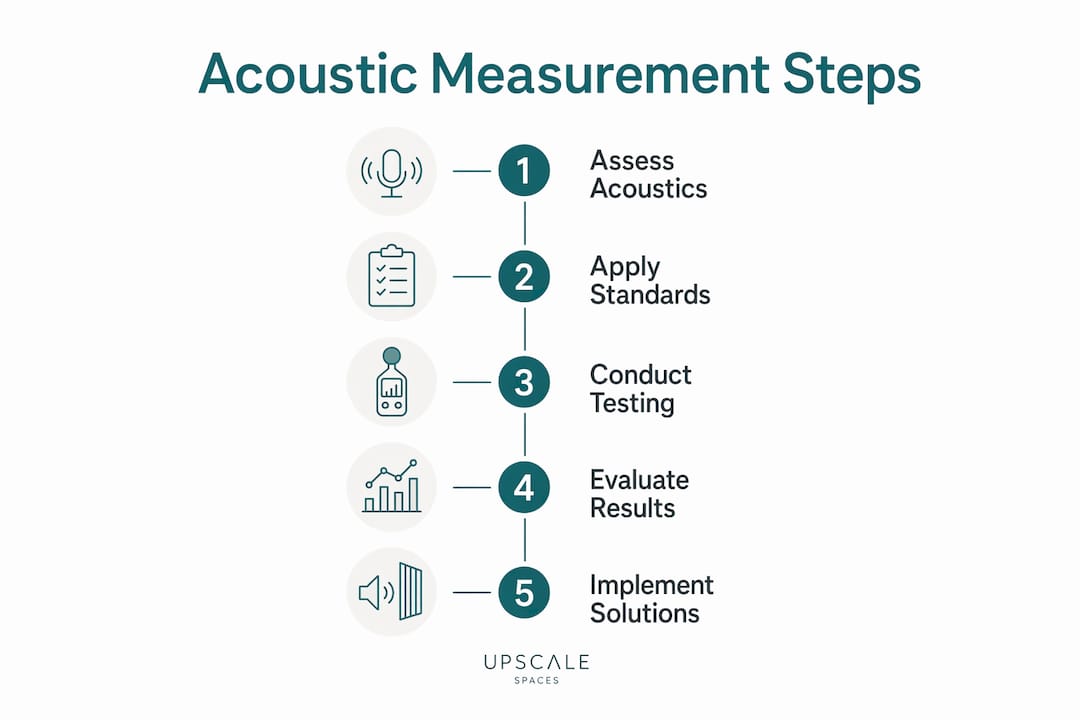
The compliance workflow involves four sequential steps:
- Octave-band RT60 prediction: Standard NRC averages are not sufficient for WELL compliance. Octave-band absorption data is required to accurately predict RT60 across the frequency range that affects speech clarity. Specify materials using full octave-band specifications, not summary ratings.
- Background noise assessment: Measure existing HVAC and external noise contributions in dBA. In Davos, alpine HVAC systems and seasonal mechanical loads can push background levels higher than standard models predict. This affects masking calibration targets.
- STI analysis: Use tools like AcousPlan to model speech transmission index across the floorplate. The design target is a distraction distance (rD) of 5 meters or less, meaning speech becomes non-distracting beyond that point.
- Post-occupancy verification: Acoustic performance must be measured after furniture, people, and equipment are in place. Occupied conditions change absorption and reflection patterns significantly compared to empty-room predictions.
Pro Tip: Engage an acoustic consultant at the concept design stage, not after construction documents are complete. Retrofitting acoustic solutions costs significantly more than specifying them correctly from the start.
ISO 3382-3 provides the measurement protocol for open-plan offices and defines the spatial decay rate of speech (D2,S) alongside distraction distance. Combining ISO 3382-3 measurements with WELL Feature 74 compliance gives you a complete picture of acoustic performance in any Davos corporate space.
What are practical design strategies to improve office acoustics?
Effective acoustic design in Davos workplaces starts with zoning. Divide the floorplate into three functional areas: quiet focus zones, collaboration zones, and social or informal zones. Each zone has different acoustic targets and requires different treatment strategies. Mixing these zones without acoustic separation is the single most common layout mistake in open-plan offices.

Workstation layout and zoning distances are as important as material selection. Open-plan offices show a double-slope speech spatial decay pattern, meaning sound attenuates quickly near the source and then more slowly at distance. Designing workstation clusters with this decay curve in mind allows you to position focus desks in the low-noise tail of the curve rather than in the high-noise zone near collaboration areas.
Specific layout and material recommendations for Davos offices include:
- Ceiling treatment: Specify tiles with NRC 0.90 or higher and full octave-band data. Cloud panels above open workstation clusters add targeted absorption where it matters most without requiring a full suspended ceiling replacement.
- Workstation screens: Desk-mounted screens at 400 to 600mm height provide meaningful blocking for seated workers. Screens with an STC rating of 20 or higher reduce direct sound transmission between adjacent desks.
- Cabinetry placement: Storage units positioned between workstation clusters act as low-cost acoustic barriers. A 1.5-meter-high cabinet row reduces direct sound paths without requiring structural changes.
- Sound masking placement: Distribute emitters above the ceiling grid at 1.5 to 2 meter spacing for uniform coverage. Uneven placement creates intelligibility hotspots where masking is insufficient and speech remains distracting.
- Private offices: For enclosed offices in Davos corporate settings, acoustic commercial doors with STC ratings of 35 or higher are the most effective single upgrade for speech privacy between rooms.
External noise from Davos’s alpine environment adds a variable that urban offices rarely face. Seasonal wind loads, mechanical plant rooms for heating systems, and ski-season activity near commercial districts all contribute to fluctuating background noise. Design your masking system with a 3 to 5 dBA adjustment range so facility managers can recalibrate without specialist intervention as conditions change.
What are the measurable benefits of acoustic improvements on employee productivity?
The business case for acoustic investment in Davos offices is direct and well-supported. Productivity gains and reduced sick leave from acoustic improvements typically yield a return on investment within one to two years after deployment. For a corporate office with 30 or more employees, that timeline is compelling compared to most capital expenditure categories.
Cognitive load is the mechanism behind the productivity link. When workers can hear and partially understand nearby conversations, the brain involuntarily processes that speech. This involuntary processing consumes working memory capacity, reducing performance on reading, writing, and analytical tasks. Reducing speech intelligibility below the STI 0.50 threshold removes this cognitive drain without requiring workers to use noise-canceling headphones or relocate to phone booths.
“Excessive reverberation degrades speech clarity and increases vocal effort, impairing productivity across the entire team, not just those nearest the noise source.”
Staff turnover and absenteeism are also affected. Chronic noise exposure in offices correlates with elevated stress, reduced job satisfaction, and higher rates of sick leave. Addressing the acoustic environment as part of a broader corporate office design strategy signals to employees that their comfort and focus are taken seriously. In Davos, where attracting and retaining skilled professionals in a high-cost location is a real operational challenge, that signal carries weight.
WELL v2 certification adds a market differentiation benefit. Certified offices in Switzerland command higher tenant interest and support ESG reporting requirements that private equity firms and institutional investors increasingly require. Acoustic compliance under Feature 74 is one of the more technically demanding WELL prerequisites, so achieving it demonstrates genuine commitment to workplace quality rather than surface-level wellness branding.
Key takeaways
Workplace acoustic solutions in Davos offices deliver measurable productivity gains, speech privacy compliance, and employee well-being improvements when absorption, blocking, and masking are applied together as a layered system.
Why acoustic planning in Davos deserves more respect than it gets
Working on office projects in Switzerland, I have seen acoustic design treated as a finishing detail more times than I can count. Teams spend months on furniture specifications and lighting schemes, then allocate two weeks at the end of the project to “sort out the acoustics.” That sequence almost always produces a space that looks excellent and sounds terrible.
The uncomfortable truth is that acoustic performance is a structural decision, not a decorative one. Ceiling heights, slab construction, partition placement, and HVAC routing all determine what is acoustically possible before a single panel is installed. By the time you are selecting wall tiles, the most important acoustic decisions have already been made, for better or worse.
Davos adds a layer of complexity that generic acoustic guides do not address. The alpine climate means mechanical systems run harder and longer than in lowland Swiss cities like Zurich or Bern. HVAC noise floors are higher, and seasonal variation is more pronounced. I have seen masking systems calibrated perfectly in October perform poorly in February because heating loads changed the background noise profile. Building in recalibration as a standard facility management task is not optional in this environment.
The other mistake I see consistently is treating open-plan office acoustics as a single problem with a single solution. Absorption addresses reverberation. Masking addresses speech intelligibility. Blocking addresses direct transmission. None of them substitutes for the others. A space with excellent ceiling absorption but no masking still has a speech privacy problem. A space with masking but no absorption forces the masking level so high that it becomes its own source of fatigue.
Start with an acoustic consultant at concept stage. Model the floorplate with STI analysis tools before committing to a layout. Specify materials with octave-band data. Verify performance after occupancy. That sequence is not complicated, but it requires discipline and early commitment. The offices that get it right are noticeably calmer, more focused, and more pleasant to work in. In Davos, that quality is worth every franc invested.
How Upscalespaces can transform your Davos office acoustics
Upscalespaces specializes in office interior design for corporate environments across Switzerland, including Davos. The firm’s end-to-end process covers acoustic planning from concept through post-occupancy verification, integrating absorption, blocking, and masking strategies into cohesive, visually refined workspaces. Projects like Mathrix AG in Zug demonstrate how acoustic performance and design quality reinforce each other in Swiss corporate settings. If you are planning an office upgrade or new fit-out in Davos, connect with the Upscalespaces design team to discuss how acoustic solutions can be built into your project from day one.
FAQ
What is the ABC method for office acoustics?
The ABC method stands for absorb, block, and cover. Absorption reduces reverberation using ceiling tiles and panels, blocking interrupts direct sound with screens and partitions, and covering raises background noise through sound masking systems to reduce speech intelligibility.
What is WELL v2 Feature 74?
WELL v2 Feature 74 is the acoustic performance standard within the WELL Building Standard. It requires offices to meet targets for reverberation time (RT60), background noise levels (dBA), and speech privacy (STI), verified through post-occupancy measurement.
Why do most offices fail WELL acoustic certification?
58% of first-submission failures under WELL v2 Feature 74 come from inadequate speech privacy. Teams typically address reverberation with ceiling treatment but underestimate how far conversational speech travels across open-plan floorplates.
What sound masking level works best in open offices?
Sound masking set between 43 and 46 dBA reduces speech STI at 4 meters below 0.40, which crosses the threshold from distracting to non-distracting. Levels above 48 dBA create their own fatigue and are not recommended for sustained work environments.
How quickly do acoustic improvements pay back in Davos offices?
Acoustic investments in corporate offices typically return within one to two years through measurable productivity gains and reduced absenteeism. In Davos, where retaining skilled staff in a high-cost location is a priority, the well-being benefits add further long-term value.
Recommended
- How to Soundproof an Office | Upscale Spaces
- Compact office space solutions for Swiss corporate teams
- Setting Up a Private Office Effectively | Upscale Spaces


