
.svg)
Office Lighting Design for Workplace Productivity in Ascona
Discover how office lighting design improves workplace productivity in Ascona. Enhance focus, well-being, and energy savings with effective strategies.
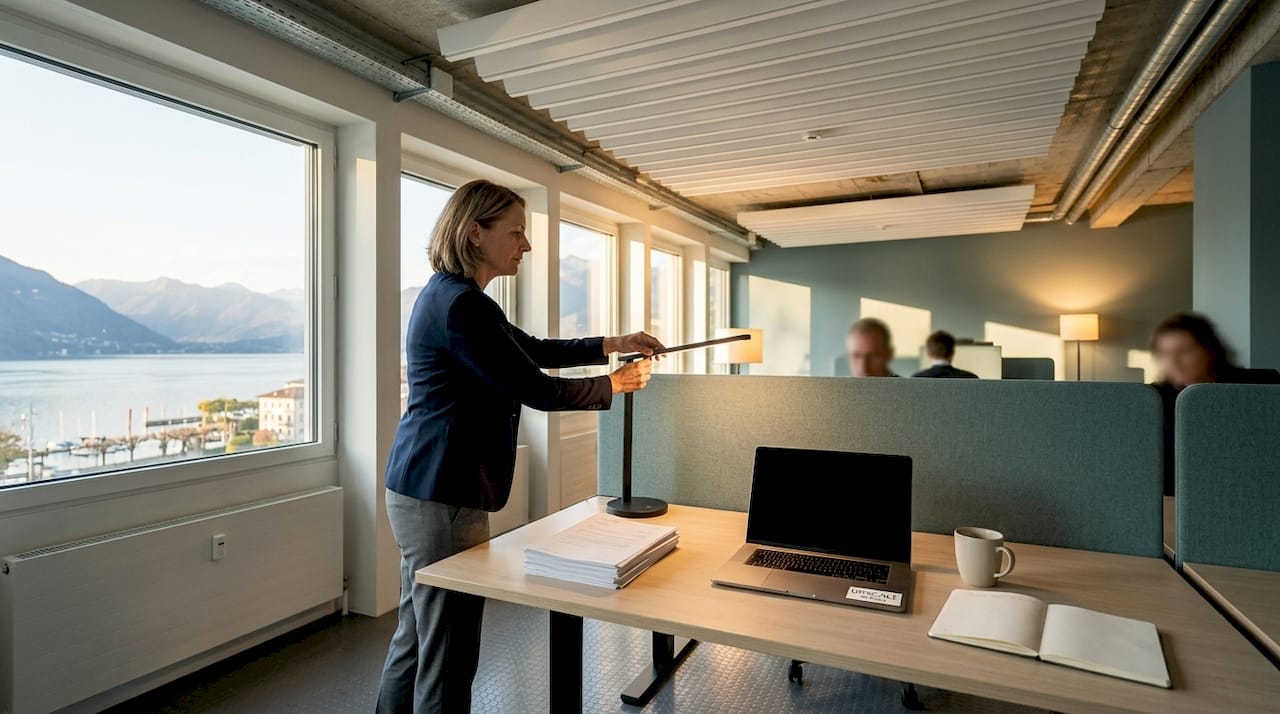
Office lighting design is a direct driver of employee focus, alertness, and well-being in corporate environments. For business leaders and facility managers in Ascona, getting lighting right is not an aesthetic choice. It is a measurable performance decision. The right combination of lux levels, color temperature, and zone-based distribution can sharpen concentration, reduce fatigue, and cut energy costs. This article covers how office lighting design improves workplace productivity in Ascona, drawing on circadian science, neuroscience-backed parameters, and practical design strategies you can apply today.
How office lighting design improves workplace productivity in Ascona
Office lighting design, known in professional practice as human-centric lighting or circadian lighting design, treats light as a tool that shapes how employees think, feel, and perform throughout the day. The core principle is simple: light quality affects biology. When lighting matches the body’s natural rhythms, employees stay alert longer, make fewer errors, and report higher satisfaction.
Ascona’s corporate offices face a specific challenge. The town sits on Lake Maggiore, offering generous natural light in summer but significantly less in winter months. A well-designed lighting strategy compensates for seasonal variation and keeps employee performance consistent year-round. Facility managers who treat lighting as a fixed infrastructure cost miss the opportunity to use it as an active productivity lever.

The business case is clear. Smart lighting and daylight harvesting sensors can reduce energy consumption by up to 75% by dimming lights in vacant areas or responding automatically to natural light. That figure represents both a financial return and a sustainability commitment, two priorities that resonate strongly with Ascona’s growing base of wealth managers and professional services firms.
What is the ideal office lighting setup for maximizing alertness and focus?
The ideal office lighting setup for cognitive work sits in the range of 300–500 lux combined with a color temperature of 5000K–6500K during peak working hours. That combination suppresses melatonin production and keeps employees in a state of active alertness. Lux measures light intensity at the work surface. Color temperature, measured in Kelvin, determines whether light appears cool and energizing or warm and relaxing.
Here is how to apply these parameters across a typical Ascona office workday:
- Morning (8:00 AM–12:00 PM): Use cool white light at 5000K–6500K and 400–500 lux at desk level to activate alertness and set a focused tone for the day.
- Midday (12:00 PM–2:00 PM): Maintain brightness but allow slight dimming in break areas to signal a natural transition without disrupting focus zones.
- Afternoon (2:00 PM–5:00 PM): Gradually shift color temperature toward 4000K in collaboration areas to support communication without inducing fatigue.
- Late afternoon (5:00 PM onward): Transition to warmer tones around 2700K–3000K in lounge and retreat spaces to support wind-down and reduce eye strain.
Exceeding 1000 lux of artificial light can overstimulate employees and induce visual fatigue, making sustained attention harder rather than easier. Brighter is not always better. The goal is calibrated light, not maximum light.
Pro Tip: Position workstations perpendicular to windows rather than facing them directly. This approach maximizes natural light exposure while eliminating glare on screens, which is one of the most common and easily corrected productivity killers in open-plan offices.
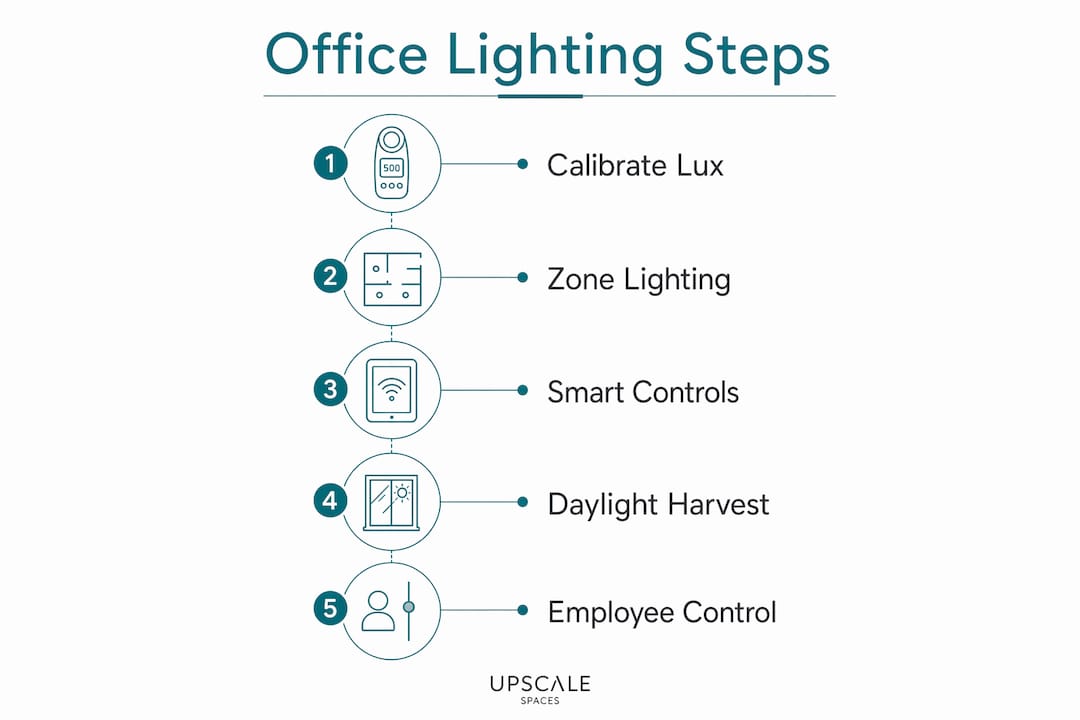
How does lighting zone differentiation enhance productivity and workplace experience?
Effective office lighting is zone-based, not uniform. A single overhead lighting scheme applied across an entire floor treats a brainstorming room the same as a deep-focus workstation, which serves neither well. Zone differentiation assigns specific lighting characteristics to specific functions, guiding employee behavior intuitively without signs or instructions.
The table below shows how lighting parameters differ across the three primary office zones:
Combining direct task lighting with indirect ambient lighting achieves visual calm and functional clarity, reducing eye strain across all zones. Direct light delivers the intensity needed for reading and screen work. Indirect light fills the surrounding space softly, preventing the harsh contrast between bright screens and dark surroundings that causes fatigue.
The zone approach also supports modern office concepts where activity-based working is the norm. Employees moving between focus pods, meeting rooms, and informal lounges experience a lighting environment that feels natural and supportive at every stop. That consistency reduces cognitive friction and keeps energy levels stable throughout the day.
What technologies and lighting controls best support productivity and energy efficiency?
Modern lighting technology gives facility managers in Ascona precise control over every variable that affects employee performance and energy use. The most effective systems combine several components working together:
- Tunable LED fixtures: Color-tunable LEDs mimic natural daylight and shift color temperature automatically throughout the day, supporting circadian rhythms without requiring manual adjustment.
- Occupancy sensors: Sensors detect when areas are vacant and dim or switch off lights automatically. Combined with daylight harvesting, occupancy sensors deliver clear ROI through reduced energy and maintenance costs.
- Daylight harvesting systems: Photosensors measure incoming natural light and adjust artificial lighting to maintain a consistent lux level at the work surface, regardless of cloud cover or time of day.
- Centralized lighting management software: Platforms like DALI-2 or KNX allow facility managers to program lighting scenes, track energy consumption, and adjust zones remotely from a single interface.
Smart lighting and daylight harvesting together can cut total office energy consumption by up to 75%. That number is significant for Ascona offices operating in modern commercial buildings where energy costs represent a meaningful portion of overhead.
Pro Tip: Give employees local control over task lighting at their workstations. Research consistently shows that perceived control over the environment increases satisfaction and reduces stress, even when employees rarely adjust the settings. The option matters as much as the action.
Human-centric lighting systems go one step further by automating the entire circadian schedule. They require an upfront investment in commissioning and calibration, but the productivity and wellness returns justify the cost for organizations with more than 20 employees sharing a space.
How does office lighting integrate with overall Ascona workplace design?
Lighting does not operate in isolation. Every surface in your office either supports or undermines the lighting scheme you install. Glossy desk surfaces, high-sheen floor finishes, and reflective monitor stands all create specular glare that causes eye strain and reduces concentration, even when the fixtures themselves are perfectly specified.
The standard benchmark for office glare control is a UGR below 19. UGR stands for Unified Glare Rating, and it measures the discomfort caused by bright light sources in the field of vision. Fixtures with a UGR below 19 are the baseline for any office environment where screen work is the primary activity.
Practical integration steps for Ascona offices include:
- Choose matte finishes for desks, monitor stands, and work surfaces. Matte finishes reduce specular glare as effectively as changing a fixture, and they cost far less to implement.
- Coordinate light color with wall and furniture tones. Warm-toned wood furniture pairs naturally with 3000K–4000K lighting. Cool gray or white palettes work better with 5000K light, which reads as clean and professional rather than cold.
- Use lighting to reinforce company identity. Accent lighting on branded walls, reception areas, and feature materials communicates culture and professionalism to clients and employees alike.
- Plan for acoustic panels and soft furnishings. These materials absorb light rather than reflect it, so factor their presence into your lux calculations during the design phase.
Coordinating lighting with office furnishings from the start of a project prevents costly retrofits later. A lighting plan developed in isolation from furniture layout and material selection almost always requires adjustment once the space is built out.
Key Takeaways
Well-designed office lighting in Ascona directly raises employee focus, reduces fatigue, and cuts energy costs when it combines calibrated lux levels, zone differentiation, and smart controls with coordinated interior finishes.
Why lighting is the most underestimated decision in office design
Most facility managers I work with treat lighting as the last item on the project checklist. It gets specified after the furniture is ordered and the floor plan is fixed. That sequencing is the single most common mistake I see in Ascona office projects, and it costs organizations real money to correct.
Lighting shapes how a space feels before an employee consciously registers anything else. A beautifully furnished office with flat, uniform overhead lighting reads as institutional and uninspiring. The same furniture under a layered, zone-differentiated scheme feels purposeful and calm. The furniture did not change. The light did.
What I find most compelling about the current state of circadian lighting technology is that the gap between “good enough” and “genuinely excellent” has never been smaller. Tunable LED systems and DALI-2 controls are now accessible to mid-sized organizations, not just large corporations with dedicated facilities teams. The investment threshold has dropped while the performance evidence has grown stronger.
My honest advice: start with glare control and zone differentiation before spending on smart controls. Fix the basics first. A UGR-compliant fixture in a well-planned zone does more for daily productivity than an automated system installed in a poorly zoned space. Build the foundation, then layer the technology on top.
Upscalespaces and office lighting design in Ascona
Upscalespaces works with corporate clients, private equity firms, and scaling businesses across Switzerland to design offices where lighting, furniture, and spatial layout work as a single system. For Ascona workplaces, the firm applies zone-based lighting principles, circadian-aware specifications, and material coordination from the first consultation through project completion. Every project follows a structured six-step process that covers design conceptualization, furniture selection, and logistics, so nothing falls through the gaps between disciplines. If you are ready to build an office environment that supports your team’s performance and reflects your organization’s standards, contact the design team at Upscalespaces to discuss your Ascona project.
FAQ
What lux level is best for office productivity?
The ideal range for focused cognitive work is 300–500 lux at the work surface. Exceeding 1,000 lux can cause visual fatigue and reduce sustained attention.
What color temperature should office lighting use?
Use 5000K–6500K cool white light during peak working hours to support alertness. Shift to 2700K–3000K in break and retreat areas to reduce fatigue.
How does lighting zone design improve employee performance?
Zone-based lighting assigns specific brightness and color temperature to each area based on its function. This guides employee behavior naturally and reduces the cognitive load of transitioning between tasks.
Can smart lighting controls reduce energy costs in Ascona offices?
Yes. Daylight harvesting and occupancy sensors can reduce total office energy consumption by up to 75% by adjusting light output automatically based on occupancy and natural light availability.
What is UGR and why does it matter for office lighting?
UGR stands for Unified Glare Rating. A UGR below 19 is the standard for office environments and indicates that fixture glare is low enough to prevent discomfort and visual fatigue during screen-based work.
Recommended
- Setting Up a Private Office Effectively | Upscale Spaces
- Compact office space solutions for Swiss corporate teams
- Lighting in the Office | Upscale Spaces
- Furnish office: Design your modern office with tips!


