
.svg)
Gstaad Office Renovations That Transform Workplace Culture
Discover how corporate office renovations in Gstaad can elevate workplace culture, enhancing collaboration and performance in unique Alpine designs.
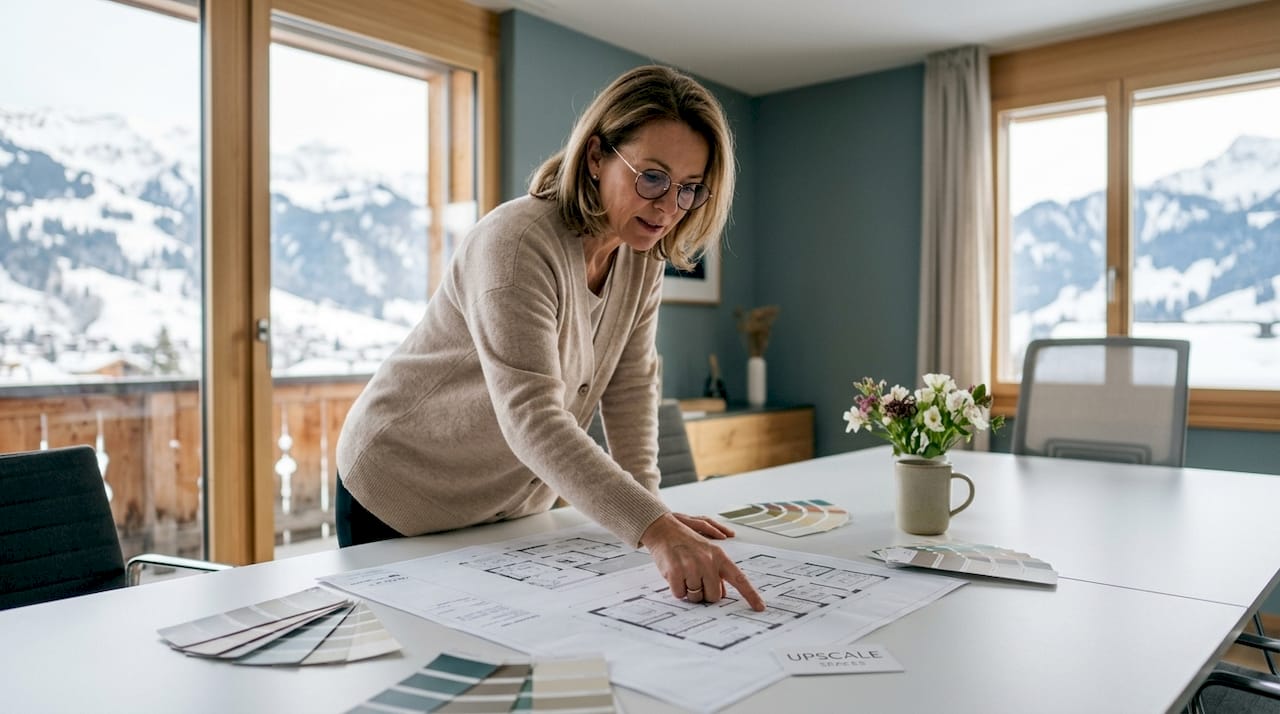
Corporate office renovation is defined as the deliberate redesign of a physical workspace to align environment with organizational values, employee needs, and business performance goals. In Gstaad, this process carries a distinct advantage: the region’s luxury hospitality tradition and Alpine design heritage give corporate clients a rich visual and material vocabulary to draw from. Understanding how corporate office renovations in Gstaad can elevate workplace culture means recognizing that space is not a backdrop for work. It is an active force shaping how people feel, collaborate, and perform. The evidence is clear, and the design opportunities here are unlike anywhere else in Switzerland.
How corporate office renovations in gstaad can elevate workplace culture
Gstaad office design draws from a tradition that prioritizes atmosphere over formality. Luxury properties like The Park Gstaad demonstrate how materials such as reclaimed wood, local stone, and warm textiles create environments that feel both grounded and inviting. Corporate offices in the region are increasingly borrowing this approach, moving away from sterile open-plan floors toward spaces that communicate warmth and belonging from the moment an employee walks in.
The impact of office renovations on culture is not cosmetic. When a workspace reflects the values of an organization through its materials, layout, and lighting, employees read that as a signal of how much the company values them. That nonverbal communication either builds trust or erodes it.

Open-plan vs. privacy-driven layouts
The debate between open-plan and privacy-focused design has a clear answer in the research. Open-plan offices underperform compared to designs that balance collaboration zones with dedicated quiet areas. Privacy features such as partitions and window views reduce psychological stress by 18.1% and improve work performance by up to 25.4%. Spatial perception improves by 73.4% when employees have access to both enclosed focus areas and shared social spaces.
In a Gstaad corporate setting, this means designing with intention. A private office with a mountain view is not a luxury perk. It is a performance tool.
Pro Tip: When planning your renovation layout, map your team’s daily work patterns first. Identify which roles need deep focus time and which depend on spontaneous collaboration. Design zones around those patterns, not around furniture catalogs.
How do office renovations improve employee well-being and performance?
Integrated Indoor Environmental Quality (IEQ) interventions in hybrid workplaces increase workspace satisfaction by 3–4 points on a 7-point scale. Collaboration access improves by 2 points and productivity-related outcomes improve by 1 point. These numbers represent a measurable shift in how employees experience their workday, not just how the office looks.

IEQ covers four interconnected factors: air quality, daylight access, acoustic comfort, and thermal regulation. A renovation that addresses all four simultaneously produces compounding benefits. Addressing only one, say, adding a few plants for air quality, produces minimal cultural change.
Daylight and ergonomics in alpine offices
Gstaad’s geography offers a natural advantage. The surrounding Alpine environment provides access to exceptional natural light, particularly in winter months when daylight is psychologically critical. A renovation that repositions workstations to maximize window exposure, combined with hybrid work scheduling that brings employees in on high-light days, creates a measurable lift in mood and focus.
Ergonomic furnishings complete the picture. Chairs and desks from manufacturers like Vitra, Humanscale, and Wilkhahn are designed to reduce physical fatigue over long work sessions. When employees are physically comfortable, their cognitive resources stay focused on work rather than discomfort.
Pro Tip: Commission an IEQ baseline assessment before your renovation begins. Knowing your starting point lets you measure real improvement after completion, which is data you can share with your board and your team.
What are best practices for renovation-driven culture transformation?
Renovation alone does not change culture. Embedding culture into business systems such as promotion criteria, hiring practices, and recognition programs is what makes a redesigned space meaningful. When the physical environment signals one set of values and the HR systems signal another, employees notice the mismatch. That gap breeds distrust faster than any design choice can repair it.
The most effective culture-driven renovations treat space as one lever among several. Leaders who understand this avoid the common mistake of expecting a new office to fix a broken culture on its own.
Here are the practices that consistently produce lasting results:
- Align layout with recognition rituals. 53% of employees cite recognition as a key reason for staying at a company. Design spaces where recognition moments can happen naturally, such as a visible team board, a shared lounge where managers can acknowledge wins publicly, or a flexible town hall area.
- Design for spontaneous collaboration. Informal idea-sharing drives innovation. Corridors, kitchen areas, and transition spaces should invite brief, unplanned conversations rather than funnel people directly from desk to meeting room.
- Involve employees in the design process. When teams contribute to decisions about their workspace, they feel ownership over the result. That ownership translates directly into pride and engagement.
- Connect space to stated values. If your company values transparency, use glass partitions in leadership areas. If you value focus, invest in acoustic pods. Every design choice should be explainable in terms of what your organization believes.
Viewing office design as a lever among many for culture change, rather than a complete solution, is the mindset that separates leaders who get lasting results from those who get a beautiful office with the same old problems.
How do you manage health and sustainability risks during renovation?
Renovation projects carry real risks to employee health and morale if not managed carefully. VOCs, particulate matter, and construction noise are the three principal hazards during active renovation phases. Each one affects employee wellbeing directly, and ignoring them during a project intended to improve culture sends a contradictory message to your team.
A health-conscious renovation framework addresses these risks before construction begins, not after complaints arise.
- Specify low-VOC materials from the start. Paints, adhesives, and flooring products all carry VOC ratings. Brands like Farrow & Ball and Forbo offer low-emission options that perform at a high level without compromising air quality during or after installation.
- Schedule high-dust and high-noise work outside business hours. This is standard practice in hospitality renovations in Gstaad and applies equally to corporate settings. Your employees should not be breathing construction dust while trying to close a deal.
- Communicate proactively with your team. Share the renovation timeline, explain what disruptions to expect, and give employees options such as temporary remote work or relocated workstations. Silence during a disruptive project reads as indifference.
- Prioritize sustainable material sourcing. Locally sourced Alpine wood and stone reduce transportation emissions and support regional suppliers. They also carry a story that resonates with employees who care about environmental responsibility.
Maintaining a clean and well-maintained workspace during and after renovation is equally important. Dust and debris from construction linger longer than most leaders expect, and a post-renovation deep clean is not optional.
Culture-driven renovations vs. traditional office upgrades
Traditional office renovations focus on aesthetics and operational efficiency. New paint, updated furniture, and reconfigured meeting rooms are the typical outputs. Culture-driven renovations start from a different question: what behaviors do we want this space to support?
The distinction produces very different results in practice.
Over 50% of employees with poor organizational culture ratings are actively seeking new jobs. That statistic reframes renovation as a retention strategy, not just a facilities decision. SHRM recommends regular culture audits to align physical space with employee experience, which means renovation planning should include an HR perspective from day one.
For Swiss business leaders evaluating their approach, the practical steps are straightforward. Start with a culture audit. Identify the behaviors your current space discourages. Then design specifically to remove those barriers. A guide on why office redesign increases output provides a useful framework for connecting design decisions to measurable business outcomes.
The benefits of renovating workspaces with culture as the primary driver extend beyond morale. They show up in recruitment conversations, client impressions, and the daily energy of your team.
Key takeaways
Culture-driven office renovation in Gstaad produces measurable gains in employee satisfaction, retention, and performance when design decisions align with organizational values and are supported by HR systems.
What i’ve learned from watching gstaad offices get it right and wrong
The offices that genuinely shift culture after a renovation share one trait: the leadership team treated the project as an organizational decision, not a facilities decision. They brought HR into the room early. They asked employees what was not working before they asked designers what would look good.
The offices that missed the mark spent generously on materials and furniture, then returned to the same management behaviors that made the old space feel uninspiring. A beautiful Alpine stone feature wall does not fix a culture where recognition is rare and autonomy is low. Space amplifies what is already there. If the underlying culture is strong, a well-designed renovation accelerates it. If the culture is struggling, renovation without behavioral change just gives the problems a nicer backdrop.
What I find genuinely exciting about Gstaad as a design context is that the local hospitality tradition already understands this. The Park Gstaad and properties like it have spent decades learning that atmosphere is not decoration. It is the experience itself. Corporate leaders in the region have access to that knowledge and to craftspeople and suppliers who know how to execute it. The opportunity to design a private office that performs as well as it looks is real here in a way that is harder to achieve in a generic business park in a larger city.
My recommendation for Swiss HR professionals and business leaders: run your culture audit before you finalize your renovation brief. The audit tells you what the space needs to do. The renovation then has a clear job to accomplish.
How Upscalespaces helps gstaad businesses redesign with purpose
Upscalespaces works with corporate clients across Switzerland to create office environments that reflect organizational values and support employee performance. The firm’s six-step process covers everything from initial consultation and design conceptualization through furniture selection and project completion, with a network of Alpine-region suppliers who understand the materials and aesthetics that make Gstaad offices distinctive. If you are ready to move from a traditional refresh to a renovation that genuinely shifts how your team works and feels, explore Upscalespaces’ office design services or review completed projects like Marmot Invest AG to see what a culture-driven approach looks like in practice.
FAQ
What makes gstaad office design unique?
Gstaad office design draws from Alpine hospitality traditions, using materials like local wood and stone to create warm, inviting atmospheres that support year-round employee engagement and wellbeing.
How much can renovation improve employee performance?
Privacy-focused design features reduce psychological stress by 18.1% and improve work performance by up to 25.4%, according to research on office privacy design.
Does office renovation alone change workplace culture?
No. Renovation must be paired with HR system alignment, including recognition programs and hiring practices, to produce lasting culture change rather than surface-level improvement.
What health risks should leaders plan for during renovation?
VOCs, particulate matter, and construction noise are the three primary risks. Specifying low-emission materials and scheduling disruptive work outside business hours protects employee health and morale.
How do i know if my renovation is culture-driven or just aesthetic?
A culture-driven renovation starts with a culture audit and maps design decisions to specific employee behaviors. If your brief does not reference values, recognition rituals, or collaboration patterns, it is likely an aesthetic project.
Recommended
- 7 Reasons why
- Setting Up a Private Office Effectively | Upscale Spaces
- Corporate Office Design | Upscale Spaces
- Your Office as Your Brand give a good impression


