
.svg)
The Role of Interior Design in Exit Value Maximization
Discover the crucial role of interior design exit value. Learn how smart design choices boost property appeal and maximize returns.

Most corporate leaders and investors treat interior design as a finishing touch, something addressed after the real financial decisions are made. That framing is expensive. The role of interior design in exit value is not cosmetic. It is structural. Well-executed design directly influences buyer perception, time on market, offer strength, and rental yield, all of which feed into your final return. Whether you are preparing a commercial property in Zurich for sale or repositioning an office portfolio in Zug for acquisition, design choices made early can add measurable value at exit.
Key takeaways
How interior design directly influences exit value
Interior design’s role in exit value goes well beyond appearances. When a buyer or acquirer walks through a space, their nervous system is already forming an assessment. Well-designed spaces signal safety, quality, and functionality before a single word is exchanged. That emotional response directly shapes offer prices and shortens time on market. For investors, fewer days on market means lower holding costs and faster capital recycling.
The financial data supports this clearly. Professional interior design increases property value by 10 to 15 percent on average. On a property valued at $2 million, that translates to $200,000 to $300,000 in added value. In high-demand Swiss markets like Geneva or Küsnacht, where buyers are sophisticated and expectations are high, that premium can be even more pronounced.
The impact operates through several specific mechanisms:
- Perceived quality: Cohesive, well-executed design signals that the property has been properly maintained and cared for, reducing buyer risk perception.
- Spatial clarity: Open, logical layouts make spaces feel larger and more functional, which directly improves buyer confidence and appraisal outcomes.
- Faster transactions: Properties that photograph and present well receive more qualified interest, compressing the sales timeline.
- Stronger negotiating position: A space that feels move-in ready gives sellers leverage. Buyers discount aggressively when they anticipate renovation work ahead.
Commercial properties in cities like Zurich and Zug face the same dynamics. A corporate headquarters or leased office floor that presents with a considered, functional interior signals to acquirers that the asset is professionally managed. That perception carries financial weight during due diligence.
High-ROI design improvements for business exit value
Not all improvements carry equal financial weight. The most effective interior design investment focuses on areas that buyers and tenants evaluate first and most critically.
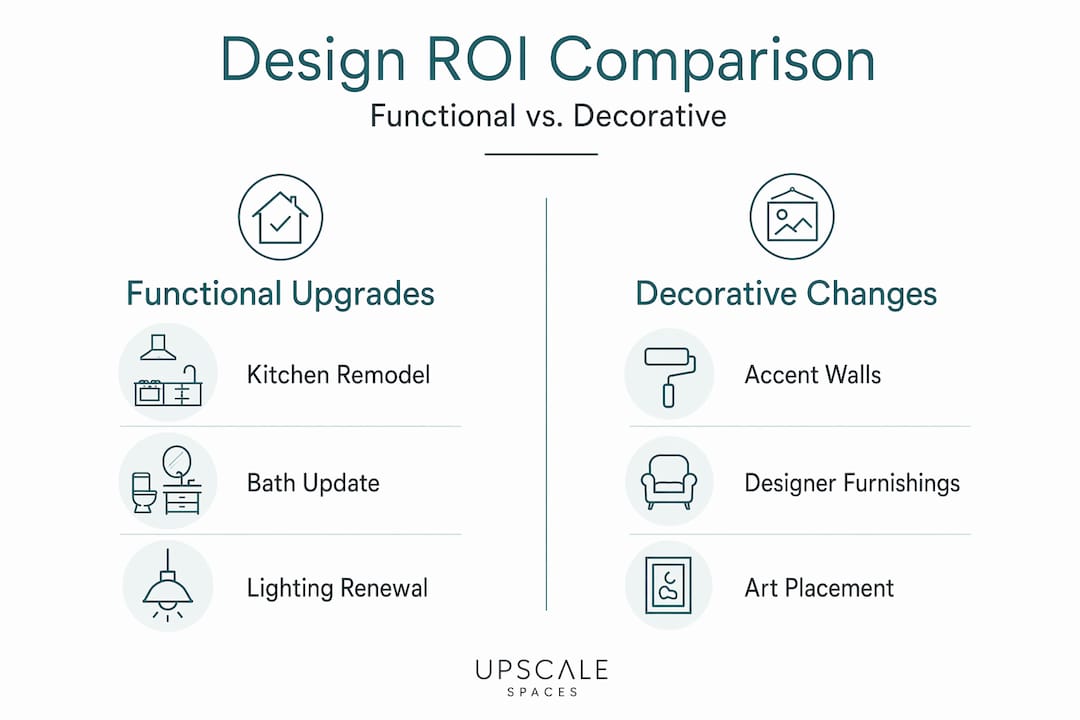
The comparison above makes one thing clear: functional improvements outperform decorative ones in virtually every category. A kitchen that works well and feels contemporary returns far more than an elaborately decorated reception area with no spatial logic.
Budget discipline matters as much as what you spend on. Renovation costs should stay below 30% of the property’s current value. Exceeding that threshold typically compresses ROI, since the marginal cost of additional upgrades rarely translates proportionally into exit price gains. This rule applies whether you are renovating a family office in Zollikon or preparing commercial floors in St. Gallen for divestment.
Pro Tip: Prioritize the first impression zones: entrance, reception, and primary meeting or living spaces. Buyers form their value judgment within the first 90 seconds, and those areas carry disproportionate weight in the overall perception of quality.
One common misstep is spending heavily on back-of-house or secondary spaces while neglecting the primary areas buyers actually experience. A polished lobby with updated lighting and curated furniture tells a better financial story than an expensive server room renovation. Focus your budget where perception is formed.
How design improves rental income before exit
For investors who hold properties before an exit event, design directly affects the yield generated during that holding period. This is where the impact of interior design compounds over time.
Professionally furnished rentals earn 15 to 50 percent more rental revenue than unfurnished or poorly presented equivalents. That premium typically pays back the furnishing investment within 12 to 18 months. In Swiss cities like Basel, Lausanne, and Lucerne, where expatriate demand and corporate housing needs sustain a strong furnished rental market, that premium is consistent and predictable.
Several specific design factors drive higher rental income:
- Furniture quality and durability: Tenants in premium segments identify quality materials quickly. Cheap furniture signals a landlord who cuts corners, which drives negotiation on price and shorter tenancies.
- Spatial flow: Properties where movement between rooms feels natural and unobstructed are perceived as more comfortable, and comfort drives renewal rates.
- Functional storage: Adequate, well-integrated storage reduces friction in daily use, which consistently ranks among the top factors in tenant satisfaction surveys.
- Cohesive lighting and color: Spaces with consistent lighting schemes and neutral, well-chosen palettes photograph better for listings and feel more settled to prospective tenants during viewings.
You can explore how quality finishes and furnishing contribute to premium rental positioning and eventual exit gains. Higher occupancy rates and longer average tenancies also reduce the administrative burden on investors, which is an indirect financial benefit that often goes uncalculated in ROI models.
Balancing trendy vs. timeless design to protect exit value
One of the most consistent mistakes in investment-focused design is selecting finishes and furnishings based on what is fashionable at the time of renovation. Trends shift within three to five years. What felt contemporary in 2021 can look dated by the time you are positioned to exit.
Timeless palettes and classic materials consistently yield better ROI than trend-driven finishes. The reason is straightforward: buyers in premium markets want to see themselves in a space without significant mental effort. Bold, highly personalized interiors force buyers to mentally renovate before they can imagine occupying the property. That friction reduces offer prices.
For investors targeting luxury Swiss markets like St. Moritz, Verbier, or Gstaad, this principle carries extra weight. Buyers in those markets are internationally experienced, have seen dozens of premium properties, and are acutely aware of what feels genuinely high-quality versus what has been styled for photography. Here are the principles that protect exit value over time:
- Choose neutral, warm palettes in primary spaces, reserving accent colors for easily replaceable soft furnishings.
- Invest in stone, solid wood, and quality metals in high-touch areas. These materials communicate lasting value without trend dependence.
- Design for spatial logic first. A room that flows well will outlast any color trend.
- Avoid custom built-ins that are highly specific to one use case. Flexible, adaptable spaces appeal to a wider buyer pool.
“Layout and spatial planning create value that endures. Aesthetic choices create value that depreciates. When you have to choose between the two, prioritize the layout every time.”
The neurological basis for this is well-documented. Spaces designed with clear circulation paths, appropriate scale, and natural light reduce cognitive load for occupants and visitors. Buyer perception and emotional response to design strongly affect offer prices. A space that feels calm and easy to navigate creates a more positive physiological response, which translates directly into financial outcomes.
Practical strategies for maximizing exit value through design
Translating design theory into exit value requires a structured approach. Here is how corporate leaders and investors can apply these insights at the asset level:
- Assess the property against market expectations first. In Zurich’s commercial market, a different quality threshold applies than in a secondary city like Winterthur. Calibrate your design investment to the buyer profile and price point relevant to your specific asset and location.
- Engage professional designers for space planning before selecting finishes. Layout decisions made early in a renovation are the most consequential and the most difficult to reverse. Getting spatial planning right is where professional expertise delivers the clearest return on design investment.
- Coordinate renovation budgets with market appraisal data. Work with your valuation advisor to understand how much value each category of improvement is likely to add in your specific submarket. Design investment without this anchoring can easily drift into over-specification.
- Time renovations to align with exit windows. Properties renovated 12 to 18 months before a planned sale present at their best. Fresh but settled interiors signal quality more convincingly than a renovation that was clearly completed the week before listing.
- Use case study evidence when presenting to acquirers. Data showing design-driven price increases of $300 per square foot in comparable markets gives institutional buyers confidence in the premium you are asking for.
Pro Tip: Commission a pre-exit design audit before engaging agents or brokers. A professional review of the space against buyer expectations in your target market will identify the highest-return improvements and flag anything that could reduce perceived value. This process typically costs far less than the price reduction you would otherwise accept.
The timely refurbishments that boost property value most consistently are those planned as part of a deliberate exit strategy, not as reactive measures after market feedback becomes negative. For office design decisions specifically, the same principle applies: intentional planning produces better financial outcomes than last-minute remediation.
My perspective on design as a financial tool
I have worked with enough investors and corporate leaders to recognize a consistent pattern. The properties that achieve the strongest exits are almost never the ones with the highest renovation budgets. They are the ones where the owner treated design as a financial discipline rather than an aesthetic preference.
What I have seen fail, repeatedly, is the assumption that spending more on visible finishes compensates for poor spatial planning. A marble reception desk in a lobby with awkward circulation still feels uncomfortable. Buyers notice the discomfort even when they cannot articulate why, and it shows up in their offers.
The disproportionate impact of layout and functional design over purely aesthetic updates is the insight I find most underappreciated in this space. Investors who understand that redesigning a floor plan, adding flexible meeting zones, or improving natural light distribution creates more lasting value than selecting premium finishes tend to exit at stronger multiples. In Swiss markets specifically, where buyers are discerning and supply of genuinely well-designed assets is limited, this distinction creates real competitive advantage.
My honest advice: allocate your first design dollar to space planning and your last to surface finishes. The sequence matters more than the total budget.
How Upscalespaces supports your exit value strategy
At Upscalespaces, we work specifically with corporate clients, private equity firms, and wealth managers across Switzerland and Europe who are preparing properties for exit or acquisition. Our process begins with understanding your financial goals, not just your aesthetic preferences, and every design decision is made with your target buyer profile and exit timeline in mind.
We have delivered projects across Zurich, Zug, Geneva, and Lausanne where intentional design choices directly supported stronger transaction outcomes. From spatial planning and furniture selection to full project coordination, our office design services are built to maximize the financial performance of your space. If you are preparing an asset for exit or want to understand what targeted design investment could add to your property’s value, explore our work through our completed office projects or connect with our design team to discuss your specific situation.
FAQ
How much value does interior design add at exit?
Professional interior design adds 10 to 15 percent to property value on average, with case studies showing price-per-square-foot increases of $300 or more in competitive markets.
What is the most cost-effective design improvement for exit value?
Minor kitchen remodels recoup up to 83% of their cost, making them one of the highest-return improvements available before a sale or exit event.
How does design affect commercial property exit value in Switzerland?
In Swiss markets like Zurich and Zug, well-designed commercial spaces signal professional management and functional quality, which reduces buyer risk perception and supports stronger offers during due diligence.
Should renovation spending have a ceiling before exit?
Yes. Keeping renovation costs below 30% of the property’s current value protects overall ROI and prevents over-capitalization that cannot be recovered through the sale price.
Does design impact rental yield before the exit event?
Professionally furnished rentals earn 15 to 50 percent more revenue, with the furnishing investment typically recovered within 12 to 18 months, improving total return over the holding period.
Recommended
- Sustainable Workspaces with Interior Design | Upscale Spaces
- Setting Up a Private Office Effectively | Upscale Spaces
- Interior design magazine for the office - trends and tips!
- Office Space Design Ideas - Home Office Setup | Upscale Spaces


