

Office Move Logistics: Swiss Compliance and Ergonomics for Facilities
Plan a Swiss office move with phased logistics, SECO safety checks, EDÖB data safeguards, coordinated design, and post move ergonomics inspections.

Start a phased logistics checklist well before move day, and secure three things first: a named project leader, a map of your IT and data dependencies, and vendor quotes with building access confirmed. Check escape routes against SECO's ArGV 4 guidance and data handling against the EDÖB's revDSG rules. At Upscale Spaces, we coordinate this kind of managed move alongside design work.
TL;DR:
- Send every mover the same written scope covering insurance, packing, storage, subcontracting, and confirmed loading access; require site visits before quotes.
- Inventory systems and dependencies, then set cutover windows, rollback steps, telephone continuity, and a full backup before move day.
- Check proposed partitions against ArGV 4 and building management before ordering furniture; your company remains liable for personal data disposal and must retain destruction certificates.
- Assign a site coordinator, IT lead, safety officer, and vendor leads; withhold final payment until the snag list closes and required certificates are filed.
Upscale Spaces
Plan Your Office Move with Design in Mind
Upscale Spaces coordinates office design and logistics, supporting workplace transformations from furniture selection through project completion.
What does a phased office relocation checklist look like at a glance?
Print this list, paste it into your project plan, and tick items off as you go.
- Early planning: appoint a project leader, review your lease, set objectives and a budget, and assemble a move committee.
- Mid planning: select movers and IT vendors, order furniture, book loading and unloading windows, and apply for any permits.
- Late planning (2–4 weeks out): tag assets, agree a packing plan, brief staff, and confirm cutover windows with IT.
- Move day: sequence zone by zone, schedule IT reconnection, and keep an on-site coordinator who collects sign-offs.
- Post-move: work through the snag list, run ergonomics checks, file data-destruction receipts, and reconcile invoices.
1. Which deliverables belong in each phase of the timeline?
Swiss SME guidance advises treating an office move as a project, with a designated project leader who coordinates IT, infrastructure and internal communication. Each phase below ends in something you can hand to a colleague.
- Early planning: Assign the project leader and define move objectives. Confirm your lease end obligations and business-continuity needs. Produce a full inventory and decide what to keep, sell or dispose of. The deliverables are an approved budget, an inventory and a risk register.
- Mid planning: Finalise the floor plan and obtain quotes from movers and IT contractors. Procure furniture, reserve loading bays and parking, and arrange temporary storage if the new space is not ready. The deliverables are signed vendor briefs and a booked access calendar.
- Late planning (2–4 weeks): Tag every asset with its destination zone, schedule packing teams, and confirm which staff move when. Redirect mail and finalise IT cutover windows and backups. The deliverables are a packing schedule and a tested backup.
- Move week and move day: Run final checks and issue the move-day run sheet. Move zone by zone, manage IT reconnection, and record signed handovers. The deliverables are the run sheet and signed handover forms.
- Post-move: Complete the snag list and verify ergonomics and safety inspections. Collect data-destruction certificates and reconcile the budget. The deliverables are a closed snag list, certificates on file and a final cost report.
How do you brief and coordinate movers, suppliers and building access?
A vague brief produces vague quotes. Write one scope and send it to every vendor so the prices compare like for like.
- State required insurance limits and the damage-claim process.
- Define the packing scope, plus disassembly and reassembly of furniture.
- Specify storage needs and duration.
- Book loading bays, parking and any temporary traffic measures in writing with building management.
- Ask for a named contact per vendor, confirm whether subcontracting is allowed, and get the service scope confirmed in writing.
- Place temporary storage where it will not block the loading bay, and sequence shipments so that bulky items arrive before small ones.
Pro Tip: Ask each mover to walk both sites before quoting. Lifts, stairwells and doorway widths cause more delay than distance does.
What should you plan for IT, telecoms and data protection?
Start with an inventory of servers, switches, workstations, cloud services and backup locations, then map which systems depend on which. Build a cutover plan with clear downtime windows and roll-back steps, and take a full backup before move day.
- Keep responsibility for personal data throughout the move. Under revDSG practice, companies remain responsible for personal data, and the company, not the waste-disposal vendor, carries responsibility for how electronic storage media are disposed of.
- Use certified partners to destroy old storage media and require destruction certificates.
- Plan telephone and internet continuity, including number porting where needed.
Disposal of electronic storage media containing personal data must be strictly controlled, and compliance responsibility stays with your company. Treat the vendor's certificate as evidence for your records, not as a transfer of liability.
Which safety, building compliance and ergonomics checks apply?
Layout decisions made for looks can fail an inspection. SECO's guidance requires escape routes to be directly accessible and unobstructed, so an extra partition can trigger costly rework.
- Check escape-route lengths against the rules in ArGV 4, Article 8 before any new partitioning goes in.
- Agree layout changes with building management and, where needed, the authorities or fire-protection (VKF) guidance.
- Add ergonomics checks to post-move snagging: adjustable desks, seating and lighting, following SUVA ergonomic guidance.
- Keep records of every safety inspection for audits.
How should move day run?
One run sheet, one communications owner. Name a site coordinator, an IT lead, a safety officer and a lead for each vendor.
- Set up early: keys, access cards and the emergency kit are on site before the first crate.
- Clear zones in the planned order, so staff areas empty and fill without crossing paths.
- Reconnect IT in the agreed windows and test each zone before moving on.
- Collect final sign-offs and complete the secure handover.
- Escalate delays through a simple matrix: vendor lead to site coordinator to project leader, with the communications owner updating staff and clients.
Small checks matter too: water the plants and keep refreshments for the crew.
What happens after the move?
Walk the new space systematically with a snag list, and mark priority fixes first.
- Schedule ergonomics assessments within the first weeks and gather staff feedback.
- File e-waste and data-destruction certificates.
- Reconcile every vendor invoice against its quote.
- Hold a lessons-learned session and archive the inventory for the next move.
Who does what, and what should the budget cover?
Name a project leader and a cross-functional move committee, each member with defined duties. Core budget lines are movers, temporary storage, IT cutover and a contingency, which can be set according to the move's complexity and risks.
- Contract clauses to include: liability, data-protection assurances, subcontracting rules and acceptance criteria.
- Keep a short sign-off sheet per phase, listing the deliverable, the owner and the date accepted.
Pro Tip: Do not release the final vendor payment until the snag list is closed and certificates are filed.
Why should design and logistics be planned together?
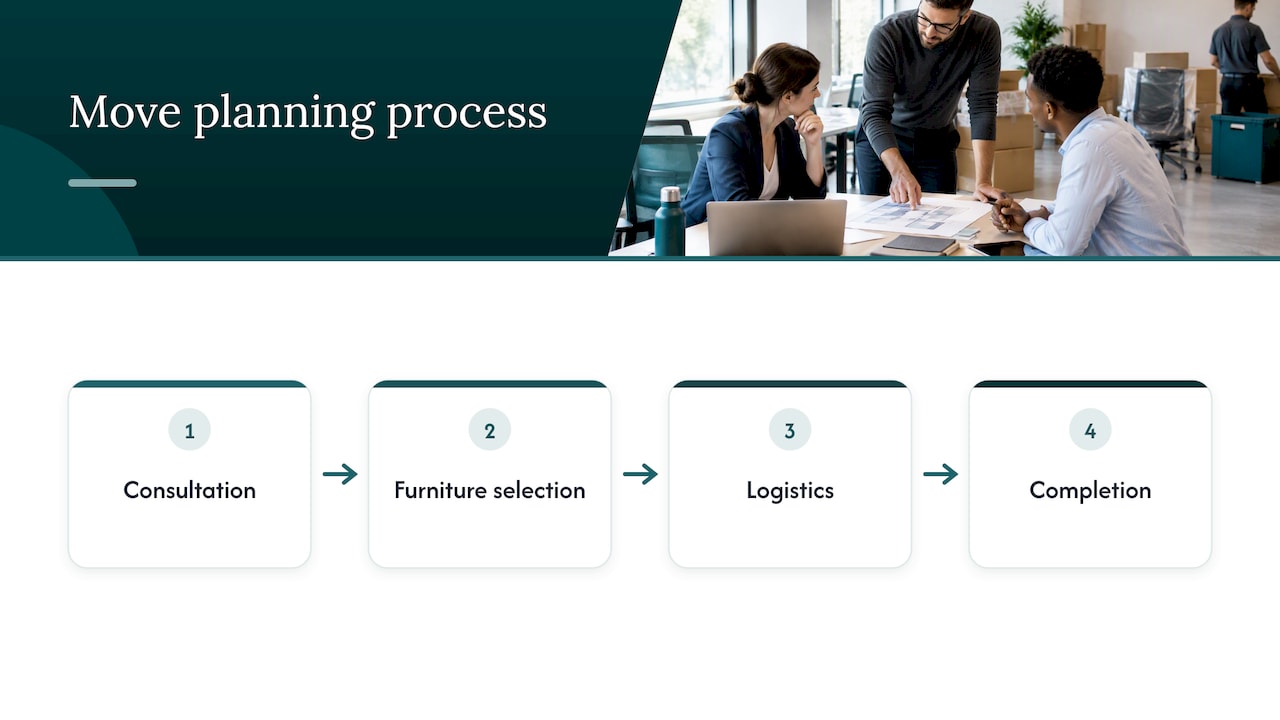
When floor planning and logistics are agreed early, safety and compliance rework shrinks and teams settle faster. Our own process, from consultation through furniture selection and logistics to completion, shows how one managed route can work. Treat this checklist as the base for a later design brief if you want integrated delivery.
Why a compliance-aware checklist beats a speed-first one
The conventional advice is to book movers early and pack efficiently. That matters, but it is not what sinks most relocations. The costly surprises tend to come from compliance gaps discovered late: an unauthorised partition that blocks an escape route, or old storage media leaving the building without proper destruction. Both are avoidable with a few early checks.

I would put three things ahead of any packing schedule. First, name the project leader, because every other decision needs an owner. Second, agree the new floor plan against ArGV 4 and building management before furniture is ordered, not after it arrives. Third, treat data protection as part of the move plan rather than an IT afterthought.
What is overrated is the perfect run sheet. A good run sheet helps, but it cannot rescue a layout that fails inspection. What deserves more attention is the quiet work after the move: ergonomics checks and snag walks decide whether the office actually works on the first Monday.
— Valerie Vecerova
Need design and logistics handled together?
If you would rather not coordinate suppliers, furniture and delivery yourself, Upscale Spaces offers end-to-end office interior design, and we can coordinate furniture procurement, supplier logistics and on-site delivery. A managed partner makes sense in these cases:
- Major fit-outs where design and move dates depend on each other.
- Tight schedules with little room for rework.
- Wellbeing-driven workplaces where layout and ergonomics shape the brief.
Tell us your move date and we will explore the next step with you.
FAQ
When should you start planning an office move?
Start well before move day. That gives you time to appoint a project leader, review the lease and secure vendors and access. Smaller moves can be shorter, but late starts mostly cost you choice of movers and loading windows.
Who should lead an office relocation?
Name one project leader who coordinates IT, infrastructure and internal communication. Swiss SME guidance on managing an office move recommends exactly this, with specialists such as safety engineers brought in where internal expertise falls short.
What happens to personal data during an office move?
Your company stays responsible for it. Old storage media must be disposed of under strict control, ideally by certified partners who issue destruction certificates, as set out in the EDÖB's data-protection guidance.
How much contingency budget should you set aside?
Adjust the amount to the complexity of your move, the age of your IT estate and how fixed your dates are.
Sources


