
.svg)
Corporate Office Relocation Planning Benefits in Neuenburg
Discover how corporate office relocation planning benefits businesses in Neuenburg. Ensure smooth transitions, reduce costs, and enhance workplace design.

Corporate office relocation planning is the structured process businesses use to move to new premises while protecting operational performance and employee well-being. For companies in Neuenburg, understanding how corporate office relocation planning benefits businesses means treating the move as a growth milestone, not just a logistics exercise. A well-planned Neuenburg corporate move controls costs, reduces downtime, and creates the conditions for a better workplace from day one. The physical transition also opens a direct window to redesign how your teams work, collaborate, and feel at their desks every day.
How corporate office relocation planning benefits Neuenburg businesses operationally
Structured planning is the single most effective way to protect business continuity during a move. Standard commercial relocations require a minimum six-month planning lead time, and organizations with more than 500 employees typically need 12–18 months. That timeline exists because every week of preparation reduces the risk of a costly gap in operations.
Scheduling is one of the clearest office relocation advantages you can act on immediately. Over 80% of Swiss corporate moves are scheduled on weekends to guarantee zero business disruption on Monday morning. That practice alone keeps client-facing teams fully functional through the transition.

Phasing the move is equally critical. Phased moves maintain production continuity by starting with non-critical departments and ending with production equipment. This sequencing prevents bottlenecks and keeps revenue-generating functions running throughout the process.
Key operational planning steps include:
- Schedule moves on weekends to protect Monday productivity.
- Phase the move by department priority, starting with support functions.
- Sequence IT infrastructure separately, with distinct disconnect and reconnect phases to prevent system failures on the first workday.
- Communicate formally with all staff at least 12 weeks before the move to stop rumors and preserve morale.
Pro Tip: Assign a dedicated internal relocation coordinator who owns the master timeline. This person becomes the single point of contact for movers, IT vendors, and facility managers, cutting miscommunication by a significant margin.
How does relocation improve employee experience and workplace design?
A Neuenburg office move is one of the most effective catalysts for workplace modernization your business will ever have. Relocation resets corporate culture and creates a natural opening to implement new flexibility and collaboration models. Employees expect change during a move, which makes them far more receptive to new working styles than they would be during a routine office refresh.
The design decisions you make during relocation directly affect recruitment and retention. A workspace with ergonomic furniture, dedicated quiet zones, and well-lit collaboration areas signals to candidates that the company invests in its people. For Neuenburg businesses competing for skilled talent in the broader Swiss market, that signal carries real weight.
Workplace changes during relocation are easier to implement because employees arrive at the new space without the habits and territorial attachments formed in the old one. That psychological reset is an asset. Use it to introduce activity-based working zones, standing desk options, or dedicated focus rooms that would have faced resistance in the previous layout.
Consider these design priorities when planning your office move:
- Ergonomic workstations that reduce physical strain and support long-term health.
- Collaboration zones with writable walls, modular seating, and good acoustics.
- Quiet focus areas separated from open-plan sections to support deep work.
- Biophilic elements such as plants and natural light to create a calm, motivating atmosphere.
- Flexible meeting rooms that can scale from one-on-one conversations to full team sessions.
Pro Tip: Involve a cross-functional group of employees in the new layout review before finalizing the floor plan. Their input surfaces practical needs that leadership often misses, and their involvement builds buy-in before the first box is unpacked.
Upscalespaces works with corporate clients across Switzerland to translate these priorities into functional office designs that reflect how teams actually work, not just how an org chart suggests they should.
Which strategic steps should Neuenburg companies follow when planning a move?
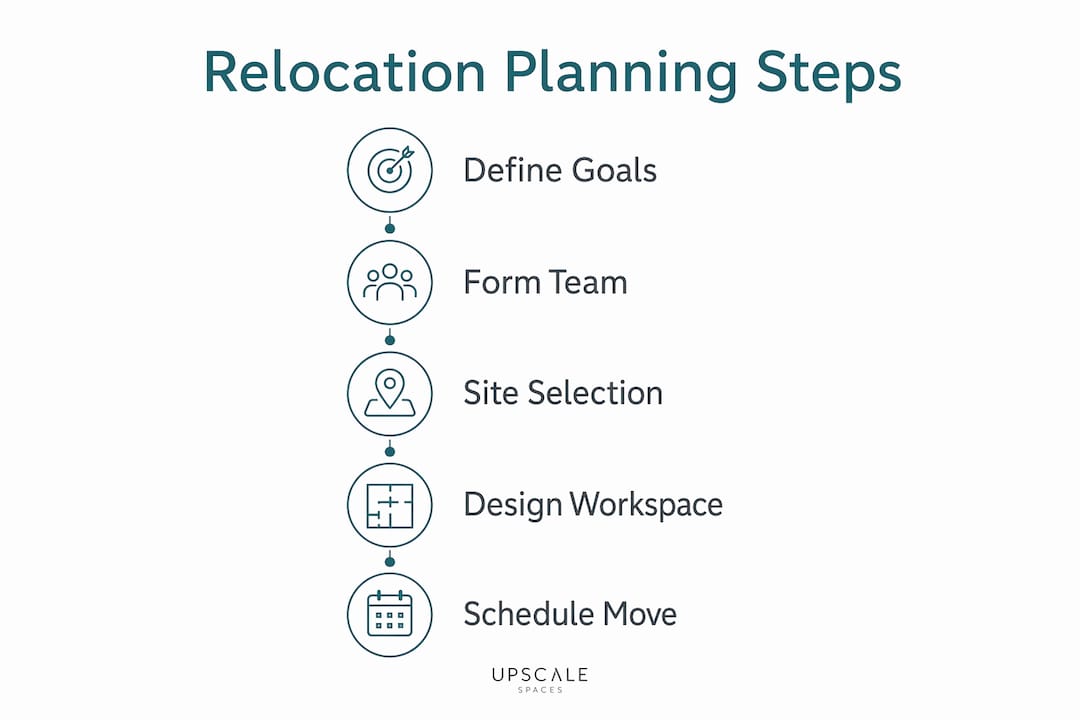
A successful business relocation strategy follows a clear sequence. Skipping steps early creates expensive corrections later.
- Define relocation goals. Align the move with specific business objectives: headcount growth, access to talent, lease cost reduction, or brand positioning. Goals shape every decision that follows.
- Form a cross-functional relocation team. Include representatives from operations, IT, HR, and finance. Add an interior design partner early so space planning runs parallel to logistics, not after.
- Set a realistic timeline. Use the 6-month minimum for smaller teams and plan for 12–18 months if your headcount exceeds 500.
- Select the site using weighted criteria. Top businesses use weighted scoring models that prioritize talent access and proximity to technical hubs. For Neuenburg, consider commute times, public transit links, and proximity to the University of Neuchâtel’s talent pipeline.
- Develop the layout plan. Map workstations, meeting rooms, storage, and breakout areas before signing the lease. Retrofitting a layout to a space costs more than designing for it from the start.
- Select vendors early. Confirm movers, IT contractors, cleaning services, and interior design partners at least three months before the move date.
| Planning phase | Recommended timeline before move |
|---|---|
| Define goals and form team | 12–18 months |
| Site selection and lease negotiation | 9–12 months |
| Layout design and vendor selection | 6–9 months |
| IT infrastructure planning | 4–6 months |
| Staff communication and phased scheduling | 3 months |
| Move execution and post-move review | Move week + 2 weeks |
IT infrastructure moves require separate disconnect and reconnect phases to avoid operational failures on the first morning back. Build that sequencing into your vendor contracts, not as an afterthought.
For Neuenburg businesses that want a reference point on compact office space solutions, Upscalespaces has documented approaches that work specifically within Swiss corporate contexts.
What are the cost benefits of well-planned office relocation in Neuenburg?
Cost control is one of the most direct benefits of office relocation when planning is done properly. Typical relocation costs run between $100 and $200 per employee, but administrative, IT, and infrastructure expenses add substantially to that baseline. Knowing this upfront lets you build a budget that reflects reality rather than optimism.
Asset audits during the planning phase are one of the most overlooked financial tools in a Neuenburg corporate move. Discarding outdated assets before the move reduces moving costs by 15–20% and prevents outdated equipment from cluttering the new space. An audit also forces a useful conversation about which furniture and technology actually supports your current workflows.
Engaging specialized firms early produces measurable savings. Specialist relocation firms reduce total moving costs by about 20% by preventing common errors in scheduling, vendor coordination, and asset handling. That saving typically exceeds the firm’s fee.
Key cost considerations to build into your budget:
- Base moving costs per employee, scaled to headcount.
- IT infrastructure setup, cabling, and server migration.
- Interior fit-out including furniture, lighting, and acoustic panels.
- Temporary storage if the new space is not ready on move day.
- Post-move cleaning at both the old and new locations, coordinated through a commercial turnover specialist.
Relocation is also the right moment to review lease terms, negotiate tenant improvement allowances, and assess whether regional grants apply to your situation. Neuenburg’s position within the Swiss economic zone means some businesses qualify for cantonal support programs when relocating to or within the region. Confirm eligibility with a local legal or financial advisor before finalizing your lease.
Key Takeaways
Structured corporate office relocation planning reduces costs, protects business continuity, and creates a direct opportunity to build a better workplace in Neuenburg.
| Point | Details |
|---|---|
| Plan early | Allow 6–18 months depending on company size to avoid costly last-minute decisions. |
| Phase the move | Start with non-critical departments and sequence IT separately to protect operations. |
| Audit assets first | Removing outdated equipment before the move cuts costs by 15–20%. |
| Design for people | Use the move to introduce ergonomic, collaborative spaces that improve retention. |
| Hire specialists | Specialized relocation and design firms reduce total costs and errors significantly. |
Why relocation is more than a logistics problem
I have worked with enough corporate clients to say this plainly: the businesses that treat relocation as a pure logistics exercise almost always regret it. They move the desks, reconnect the cables, and then spend the next 18 months trying to fix a workplace that never quite fit the team that moved into it.
The companies that get it right treat the move as a reset. They ask harder questions before the floor plan is drawn. What does collaboration actually look like for this team? Where do people go when they need to focus? What does the space say to a candidate walking in for the first time?
The communication piece is the one I see underestimated most often. A formal leadership announcement 12 weeks before the move stops the rumor cycle before it starts. Rumors cost productivity. They also cost trust, and trust is harder to rebuild than a server rack.
My honest advice for Neuenburg decision-makers: bring your interior design partner into the conversation at the same time you bring in the movers. The layout decisions and the logistics decisions are not separate problems. They feed each other. A well-sequenced move into a well-designed space is the outcome worth planning for.
— Tom
Upscalespaces supports Neuenburg businesses through office design and relocation
Upscalespaces specializes in corporate office design across Switzerland, working with businesses at every stage of a relocation. The firm’s six-step process covers initial consultation, layout conceptualization, furniture selection, and full project coordination through to completion. For Neuenburg companies planning a move, that end-to-end support means design and logistics stay aligned from the first meeting to the final walkthrough. Upscalespaces partners with established furniture manufacturers and a broad network of Swiss logistics contacts to deliver spaces that work for your team from day one. Reach out through the corporate office design contact page to start a conversation about your relocation.
FAQ
How far in advance should a Neuenburg company start planning an office move?
Standard relocations require at least six months of planning lead time. Companies with more than 500 employees should allow 12–18 months to avoid operational disruption.
What is the typical cost range for a corporate office relocation?
Base moving costs run between $100 and $200 per employee, with additional budget needed for IT setup, interior fit-out, and administrative expenses.
How does office design fit into relocation planning?
Relocation is the best opportunity to redesign your workspace because employees arrive without entrenched habits. Introducing ergonomic furniture, collaboration zones, and focus areas at move-in produces better adoption than retrofitting an existing space.
How can Neuenburg businesses reduce relocation costs?
Conducting an asset audit before the move and engaging specialist firms early are the two most effective cost controls. Audits cut moving volume by removing outdated equipment, and specialists prevent the scheduling errors that create expensive delays.
When should leadership communicate a planned office move to employees?
A formal written announcement from leadership at least 12 weeks before the move date stops rumors and preserves team productivity through the transition period.


