
.svg)
Why office redesign increases output: a leader's guide
Discover why office redesign increases output by up to 20%. Unlock productivity with strategic changes in design for a more effective workspace.
Most corporate leaders treat office design as a facilities budget line, not a performance lever. That framing is expensive. Research shows that strategic office redesign can increase employee output by up to 20% through targeted improvements to acoustics, lighting, air quality, and workspace variety. This article explains exactly why office redesign increases output, which design factors move the needle most, and how facility managers can plan a redesign that delivers measurable, lasting gains rather than just a fresh coat of paint.
Table of Contents
- How strategic office design drives productivity
- The hidden productivity cost of open-plan offices
- How air quality and environmental health boost employee output
- Designing for workflow efficiency and focus zones
- Comparing office redesign approaches: open plan, activity-based, and private workspaces
- Why most office redesigns miss the mark on output — and how to avoid it
- How Upscale Spaces can transform your office redesign
- Frequently asked questions
Key Takeaways
| Point | Details |
|---|---|
| Office design improves output | Strategic redesign can boost employee productivity by around 20% by addressing acoustics, lighting, air quality, and workspace variety. |
| Acoustic quality matters most | Controlling noise and speech distractions is key to enabling deep focus and reducing cognitive interruptions in office environments. |
| Air quality raises cognition | Improved ventilation and low pollutants increase cognitive function by up to 61%, greatly enhancing decision-making and productivity. |
| Layout reduces friction | Aligning spatial zones with real work modes minimizes wasted time and interruptions, increasing effective work hours. |
| Measure to validate | Baseline and ongoing productivity measurement ensures redesign changes deliver actual, sustained output improvements. |
How strategic office design drives productivity
The most common mistake in office renovation planning is treating aesthetics as the primary goal. A new color palette or trendy furniture will not move your productivity numbers. What does move them is the functional environment your employees work inside every day.
Four factors consistently show up in the research as the biggest drivers of office environment and employee output:
- Acoustic quality: Unwanted speech is the single most disruptive element in most offices. When employees can hear nearby conversations, their brains process that speech involuntarily, consuming cognitive resources they should be directing at their work.
- Lighting quality: Natural light and well-designed artificial lighting reduce eye strain, regulate circadian rhythms, and improve alertness across the workday.
- Air quality: CO2 buildup and poor ventilation impair decision-making and increase error rates in ways most employees never consciously notice.
- Workspace variety: Providing different settings for focused work, collaboration, and informal conversations lets people match their environment to the task, rather than forcing every work mode into one layout.
“Workplace design that addresses acoustics, lighting, air quality, and work setting variety can increase productivity by 20% — a figure that dwarfs the cost of most redesign projects when measured against labor spend.”
The benefits of office redesign are not theoretical. They are grounded in specific, measurable environmental variables. If your redesign plan does not explicitly address all four factors above, you are leaving output gains on the table. For a deeper look at one of the most overlooked factors, soundproof office insights from our team explain how acoustic design translates directly into focus time. And if you want context on where the industry is heading, modern office design trends covers the shift toward performance-focused environments.
The hidden productivity cost of open-plan offices
Open-plan offices became the default layout for a reason: they are cheaper to build, easier to reconfigure, and they signal a culture of transparency. The problem is the data on their actual impact on output is damaging.
Open-plan offices can cause productivity drops of up to 66% due to noise and speech distractions. That is not a marginal dip. That is a majority of your employees’ cognitive capacity being bled out by the layout you chose to save money on construction.
Here is what actually happens in a typical open office:
- Face-to-face communication drops as employees avoid disrupting colleagues, and electronic messaging increases instead, slowing decisions.
- Intelligible speech nearby triggers involuntary processing, pulling attention away from deep work even when employees believe they are focused.
- Employees in open spaces report significantly lower engagement and higher stress, especially during complex or creative tasks.
- Context switching increases because there is no physical or acoustic signal to protect focus time.
The redesign response is not to eliminate open areas entirely. It is to layer in acoustic zones, phone booths, and private focus rooms that give employees genuine choice. Designing acoustic zones is not just about comfort. It is about protecting the cognitive conditions that produce your highest-value work.
| Layout type | Collaboration support | Focus protection | Acoustic control | Productivity risk |
|---|---|---|---|---|
| Fully open plan | High | Very low | None | Very high |
| Open plan with zones | Moderate | Moderate | Partial | Moderate |
| Activity-based working | High | High (if designed well) | Varies | Low to moderate |
| Assigned private offices | Low to moderate | Very high | High | Low |
Pro Tip: Before committing to a redesign concept, audit how your teams actually spend their time. If more than 40% of the workday involves individual focused work, an open plan without acoustic solutions will consistently underperform. The open office challenges article on our blog walks through this audit process in practical terms.
How air quality and environmental health boost employee output
Most facility managers focus on visible design elements and overlook the invisible ones. Air quality is the clearest example of an invisible factor with outsized impact on employee output.
Improved indoor air quality can increase cognitive performance by up to 61% in controlled environments. To put that in concrete terms: the same employee, doing the same task, in a better-ventilated room can produce work that is dramatically more accurate and better reasoned.
The mechanisms are straightforward:
- CO2 concentration: As CO2 builds up in a poorly ventilated space, it impairs decision-making speed and accuracy. Most standard offices exceed optimal CO2 thresholds by mid-morning.
- Volatile organic compounds (VOCs): Off-gassing from furniture, carpets, and cleaning products creates a low-level chemical load that reduces alertness over time.
- Thermal comfort: Offices that are too warm reduce alertness; those that are too cold increase physical discomfort and distraction. The optimal range for cognitive work is narrower than most HVAC systems are programmed to maintain.
- Daylight access: Natural light regulates sleep cycles and directly affects mood, energy, and sustained attention during work hours.
Key stat: Upgrading ventilation to meet green building standards delivers one of the highest ROI figures of any office improvement, because the cost of better airflow is small relative to the labor cost of the employees working in that space.
Green building frameworks provide validated checklists for health-focused office design, covering air quality, thermal comfort, lighting, and materials. If your redesign is not referencing one of these frameworks, you are designing without a map. Our guide to sustainable workspace design explains how to apply these principles without turning your office into a wellness showroom.
Designing for workflow efficiency and focus zones
Even a well-ventilated, acoustically controlled office will underperform if the physical layout creates friction in how work actually flows. This is where the impact of workspace layout becomes a daily tax on productivity.
Traditional office layouts are often inherited rather than designed. Departments end up in locations based on history, not on how teams collaborate or where focus work happens. The result is constant low-level inefficiency: unnecessary walks, accidental interruptions, and meetings that happen in the wrong kind of space.
Here is a practical approach to redesigning for workflow efficiency:
- Map your actual work modes. Before drawing a single floor plan, document how each team spends its time. What percentage is deep focus? Collaborative? On calls? The ratio determines the zone allocation.
- Create distinct zone types. Every office needs at least three: a focus zone (quiet, private or semi-private), a collaboration zone (open, writable surfaces, flexible furniture), and a social zone (informal, away from workstations).
- Design collision points intentionally. Casual hallway conversations drive innovation and relationship-building. Place shared resources like coffee stations and printers at the boundaries between zones to encourage cross-team contact without disrupting focus areas.
- Assign private workspaces where deep work dominates. For roles requiring sustained concentration, designing private offices reduces context switching and increases the hours of uninterrupted work per day.
- Measure before and after. Track focus time, interruptions per hour, and space utilization before the redesign. Revisit those numbers 90 days after. Without this baseline, you cannot distinguish real gains from the novelty effect of a new space.
Pro Tip: Smart office solutions including occupancy sensors and booking systems give you the usage data to validate whether your zone design is actually working, and where to adjust.
Matching space zoning to team work modes reduces friction and wasted time, which translates directly into measurable output gains. This is why workspace redesign matters beyond aesthetics: it is an operational change, not a cosmetic one.
| Zone type | Primary function | Key design features | Output impact |
|---|---|---|---|
| Focus zone | Deep individual work | Acoustic separation, assigned seating | High for complex tasks |
| Collaboration zone | Team work, ideation | Open layout, writable walls, flexible furniture | High for creative output |
| Social zone | Informal interaction | Comfortable seating, away from workstations | High for culture and retention |
| Phone/video zone | Calls and virtual meetings | Soundproofing, good lighting, stable tech | High for communication quality |
Comparing office redesign approaches: open plan, activity-based, and private workspaces
Understanding why office renovation increases productivity requires comparing the three dominant redesign models honestly, including their failure modes.
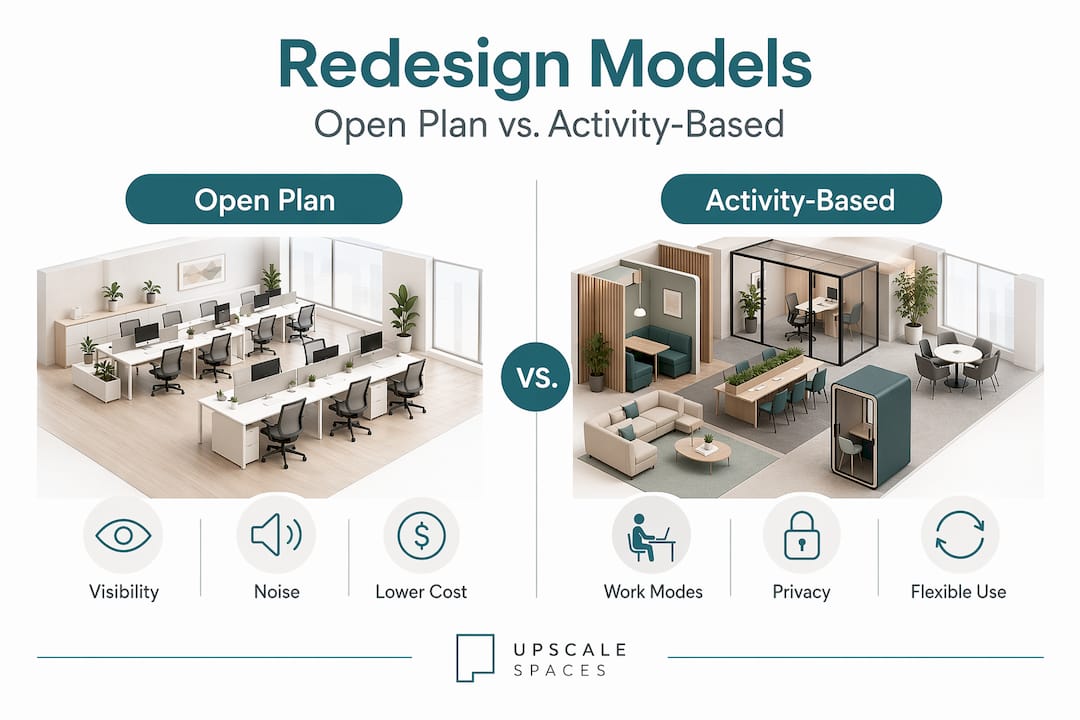
Open plan: Maximizes visibility and reduces real estate cost per person. The trade-off is persistent noise, reduced privacy, and lower deep-work capacity. Without acoustic interventions, open plans consistently underperform on output metrics for roles requiring sustained focus.
Activity-based working (ABW): Provides a range of settings for different work modes and removes assigned seating. When designed well, with genuine acoustic separation between zones, ABW can support high output. When designed poorly, it becomes an open plan with more furniture categories and the same noise problems.
Assigned private workspaces: The data here is clear. Moving from open-plan to private workspaces increased focus time and deep work hours by 40%, with measurable operational gains. For engineering teams, legal departments, finance functions, and any role where output quality depends on uninterrupted concentration, private or semi-private workspaces consistently win.
Key considerations when choosing a redesign model:
- Roles that require deep focus for more than 3 hours per day should have acoustic protection built into their primary workspace, not just available in a separate room.
- Activity-based working requires strong change management. Without it, employees default to the same spot every day, defeating the purpose.
- Hybrid work patterns have changed utilization rates significantly. Redesigns that do not account for peak occupancy days versus low-occupancy days waste space and budget.
Explore the full range of modern office concepts to see how these models are being applied in current European corporate projects.
Why most office redesigns miss the mark on output — and how to avoid it
After working on office transformations across Europe, the pattern in failed redesigns is consistent. Leaders invest in the visible: new furniture, a fresh palette, a statement reception. They underinvest in the invisible: acoustic performance, speech privacy, and air quality. The result looks better but performs the same.
Optimizing aesthetics without prioritizing acoustic and privacy design is the fastest way to lower deep-work time. We have seen this play out in companies that spent significantly on redesigns and then reported no change in employee satisfaction scores six months later. The reason is almost always that the noise environment was not addressed.
The second failure is the absence of measurement. Without a pre-redesign baseline of focus time, interruptions, and output quality, there is no way to know whether the redesign worked. Leaders end up relying on anecdotal feedback, which tends to reflect the novelty of the new space rather than its functional performance.
The third failure is layout that ignores how work actually flows. Workflow pathing, the routes employees take between their workstations, meeting rooms, and shared resources, creates either friction or efficiency depending on how thoughtfully it is designed. Most redesign briefs never mention it.
Our practical advice: start with soundproof office strategies as a non-negotiable, establish measurement before you move a single piece of furniture, and map your team’s actual work patterns before committing to a layout. Redesign that improves output is an operational discipline, not a design trend.
How Upscale Spaces can transform your office redesign
Knowing what drives output is one thing. Executing a redesign that actually delivers those gains is another.
At Upscale Spaces, we work with corporate leaders and facility managers across Europe to design offices that perform, not just impress. Our office design experts bring evidence-based thinking to every project, from acoustic zoning and air quality planning to workflow-matched layouts and furniture selection. We manage the full process, from initial consultation through to project completion, so your team stays focused on the business while we handle the transformation. You can see the results in our office design projects portfolio, where measurable improvements in productivity and employee satisfaction are part of every brief. If acoustic performance is your starting point, our work on soundproof office techniques gives you a concrete foundation to build from.
Frequently asked questions
How much can a strategic office redesign improve employee productivity?
A well-planned redesign can increase productivity by about 20% through targeted improvements to acoustics, lighting, air quality, and workspace variety. The gains are largest when all four factors are addressed together rather than in isolation.
Why do open-plan offices often reduce productivity?
Open-plan offices expose employees to intelligible speech, which the brain processes involuntarily, creating cognitive load that reduces focus. Productivity can drop by up to 66% in high-noise open environments, particularly for roles requiring deep concentration.
What role does indoor air quality play in office productivity?
Poor air quality, particularly elevated CO2 and VOC levels, impairs decision-making and increases errors. Air quality improvements can raise cognitive performance by up to 61%, making ventilation one of the highest-ROI investments in any office redesign.
How can office layout reduce work friction and improve output?
Matching space zones to team workflows reduces the time employees spend searching for appropriate spaces, managing interruptions, and switching context. Distinct focus, collaboration, and social zones align the environment with how work actually happens.
What is the importance of measuring productivity changes during redesign?
Without a pre-redesign baseline, leaders cannot distinguish genuine output gains from the novelty effect of a new space. Tracking focus time and output metrics before and after confirms which design changes actually drive performance.


